BACKGROUND
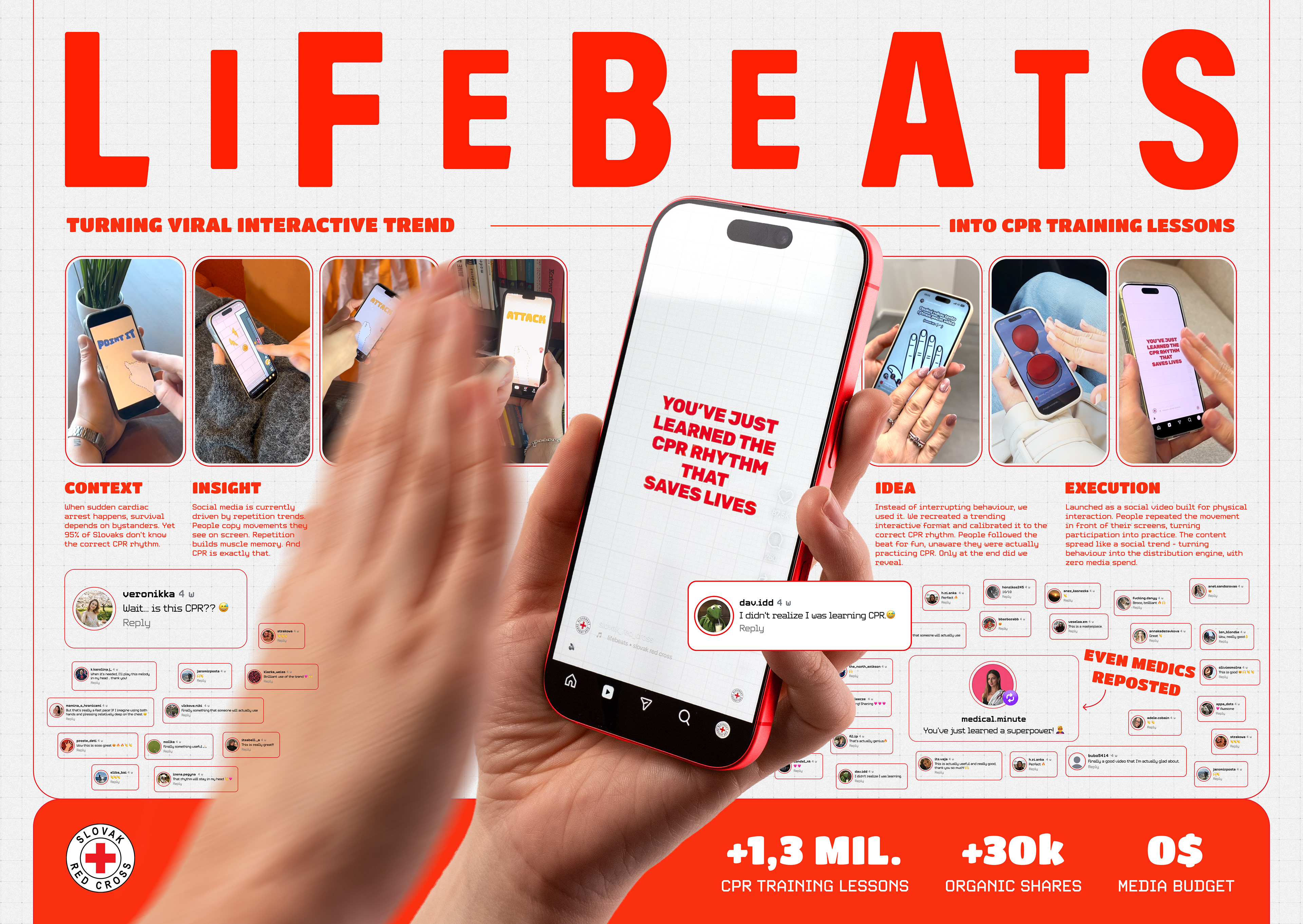
In Slovakia, fewer than 5% of people know the correct CPR rhythm. Traditional educational content struggles to reach people online, while millions instinctively copy simple social media trends every day.
INSIGHT
People rarely stop scrolling to learn CPR. But immersive, interactive social media trends can make millions repeat the same hand movements over and over again, simply to hit the right rhythm.
That repetitive behaviour was already remarkably close to CPR training - it just needed the right beat.
In Slovakia, fewer than 5% of people know the correct CPR rhythm. Traditional educational content struggles to reach people online, while millions instinctively copy simple social media trends every day.
INSIGHT
People rarely stop scrolling to learn CPR. But immersive, interactive social media trends can make millions repeat the same hand movements over and over again, simply to hit the right rhythm.
That repetitive behaviour was already remarkably close to CPR training - it just needed the right beat.
IDEA
So instead of teaching CPR, we made people accidentally learn it.
We recreated a familiar interactive social media format, but calibrated every movement to 114 BPM - the correct rhythm for chest compressions. People copied the movements thinking they were simply playing along with another trend.
Only at the end came the reveal: “You just learned the CPR rhythm that can save a life.”
By disguising training as entertainment, LifeBeats turned scrolling into practice and repetition into muscle memory.
So instead of teaching CPR, we made people accidentally learn it.
We recreated a familiar interactive social media format, but calibrated every movement to 114 BPM - the correct rhythm for chest compressions. People copied the movements thinking they were simply playing along with another trend.
Only at the end came the reveal: “You just learned the CPR rhythm that can save a life.”
By disguising training as entertainment, LifeBeats turned scrolling into practice and repetition into muscle memory.